Senior living marketing is not where it was five years ago. The websites are better. The branding is stronger. Whole agencies now specialize in this industry rather than treating it as one vertical of many. CRMs connect to websites. Automations exist. There are tools for chat, lead routing, nurturing, and reporting. Cost calculators try to give clarity around what someone may be spending. Surveys help guide families to the right care level. On every dimension the industry has chosen to invest in, the investment has paid off.
And yet when you follow the actual journey, from the first search to the first call to the first tour, something still feels off. Lead volume looks fine on paper. Pipelines look healthy in the CRM. The activity reports show motion. But occupancy is not moving the way the activity would suggest it should, and at some point the gap between those two numbers becomes the real conversation.
The reason is not that the tools are wrong. The tools are better than they have ever been. The reason is that the center of gravity of the industry has shifted, and most marketing systems were built around where it used to be. Most senior living funnels are still pointed inside out, starting from the community and what it offers, and then layering more platforms on top of that original direction every time a new vendor comes through the door. The pyramid is upside down. And no amount of new technology fixes a system that was structured the wrong way from the start.
A lot of what follows came from working inside this space at the operator level, the agency level, and the management company level. From sitting with operators trying to figure out why their pipeline looks healthy but their occupancy is not moving. From working alongside multi-community organizations where each property has a slightly different stack and a slightly different version of the same problem. From being inside agencies doing genuinely good work and still watching leads fall through gaps that nobody built a bridge for. My proximity changed how I look at the gaps. They stop being theoretical and start being very familiar.
The Industry Has Caught Up on Tools
The investment has been real. Senior living now has its own purpose-built CRMs, conversational AI platforms, lead routing systems, marketing automation tools, and assessment products that route care-level questions to the right team member. There are call tracking platforms, reputation management tools, virtual tour vendors, and chat assistants that can carry a multi-turn conversation well enough that a family member often does not realize they are not speaking with a community team member.
The infrastructure side of the industry has matured in a way that would have been hard to predict five years ago. There are now multiple annual conferences dedicated specifically to digital marketing in senior living. SMASH is the most visible of them, drawing operators, agencies, and platform vendors into one place to talk through what is working and what is not. The fact that an event of that scale exists, and that it has grown every year, is itself a signal. Senior living is no longer borrowing its digital marketing playbook from real estate or hospitality. The industry has built its own.
What has not caught up is the thinking around how all of these tools are supposed to work together. Each platform is good at what it does. Each integration is technically possible. Each new feature solves a real problem. But the system, the actual end-to-end experience a family member moves through from the first search to the first call, was rarely designed as one thing. It got assembled in pieces, at different times, by different people, for different reasons. And nobody went back to ask whether the pieces add up to something coherent from the outside looking in.
That is the gap. Tools do not fix strategy. Integrations do not fix alignment. And no amount of new technology fixes a system that was never designed as one to begin with.
The Problem Is Not the Website. It Is the Alignment
Most conversations about underperforming senior living marketing start with the website. The site looks dated. The forms feel clunky. The CTAs are unclear. So the conversation goes to a rebuild, or a redesign, or a different web vendor.
Sometimes the website really is the problem. More often, it is just where the problem shows up.
The real issue is alignment. Alignment between what the ads promise and what the website delivers. Alignment between what the website offers and what the forms ask for. Alignment between what the forms capture and what the CRM does next. Alignment between what the CRM hands to sales and what sales actually does with it. When any of those connection points break down, friction builds in the system. And friction shows up downstream as poor conversion, long decision cycles, and leads that feel unqualified by the time they reach a sales counselor.
When the system is not aligned, every team feels it differently. The sales team feels it in the quality of the leads they are working, the ones that look promising in the CRM but never quite convert into anything real. Marketing feels it in the metrics that look fine on paper, the form fills and click-through rates and engagement numbers, but never seem to translate into the occupancy numbers leadership is asking about. Leadership feels it in the gap between the activity the marketing reports describe and the move-ins the operations reports describe. Each team is looking at a different slice of the same problem, and the problem is rarely the slice they can see.
We Keep Adding Layers Instead of Fixing the Foundation
There is always a new platform. A new tool. A new feature promising better results. And the instinct is to add it, because adding feels like progress. That instinct is understandable. Being someone who is both a tech person and a marketer means that when a vendor shows how cleanly their product integrates, how naturally it slots into the existing stack, it is hard not to be interested. The pull is real.
But there is always a question that sits underneath the demo, and it does not get asked nearly enough. Do you actually need this? Because adding more to a disconnected system does not make the system more functional. It makes it more complicated. And complication, in a marketing stack, almost always means it gets harder to understand what is actually working versus what is just generating activity.
This is where the audit conversation gets uncomfortable. Most operators have invested in at least one platform they are barely using. Most have an automation that fires every day but nobody has read in months. Most have at least one integration that is technically connected but only passes data in one direction, or on a delay, or with fields mapped incorrectly. The stack looks impressive in a vendor demo. In daily operation, large parts of it are doing nothing, or worse, doing something that quietly conflicts with another part of the stack.
The answer is not to keep adding. The answer is a system designed with intention, where each piece knows what the other pieces are doing and where every tool earns its place in the workflow. That is a different exercise than evaluating the next platform. It is the exercise that has to happen first.
Senior Living Is Not a Transaction
This is where most strategies break, because senior living borrows ideas from other industries that do not fully apply.
Real estate makes sense as a reference point because a community is, in part, a residence. Hospitality makes sense because the lived experience inside a community matters enormously. E-commerce makes sense because the modern funnel logic of capturing intent and nurturing through it does apply in pieces. But none of those frames fully translate. Senior living is not an RV showroom where someone walks in to choose their next adventure. It is not a hotel they are picking for a long stay. It is not a lifestyle upgrade someone casually shops for on a Tuesday afternoon.
This is not something someone just wants. It is something they need. And the semantics matter more than they might seem to. When senior living gets treated like a product, the marketing reflects that. It becomes features, amenities, surface-level benefits. The websites lead with what the community offers rather than what the visitor is trying to understand. The follow-up sequences lead with what the community wants to say rather than what the person on the other end is trying to figure out.
The person on the other side is not looking for features. They are looking for clarity. Reassurance. A sense that someone on the other end of this understands what they are actually going through. This decision is emotional. It involves multiple people, often across multiple generations. It is tied to health, safety, timing, and finances in ways that no other purchase decision is. It is not something anyone moves through quickly or lightly, and the marketing cannot just inform its way through that. It has to guide.
The Funnel Was Built Backwards
Most senior living marketing starts from the community. What services do we offer? What do we want to highlight this quarter? What makes us different from the community down the road? From there, everything gets built outward. The website copy, the ad messaging, the email sequences, the chatbot scripts, the sales talking points. All of it inherits a starting direction that nobody necessarily decided on, but that quietly shapes everything that follows.
It is easy to read that and disagree. The resident and the family are always at the center of the conversation. Every marketing meeting is about the family member’s experience. Every campaign is built around how to make the family feel supported. But the more honest question is whether that is really the starting point, or whether the starting point is how to present what the community offers in the best possible light, and the family-focused framing is the wrapper that gets put around it after the structure is already set.
Those are two very different exercises. They produce two very different systems. And one of them, the more common one, results in marketing that looks like it is about the family but is structurally about the community. The funnel was built from the inside out. Every tactic that gets added downstream inherits that direction. And the cumulative effect, over years of campaigns and content and sequences, is a system that generates the activity of marketing and reports the metrics of marketing without ever quite landing with the person it was meant to reach.
Invert the Pyramid
The fix is to start with the person making the decision. Not the services. Not the differentiators. The resident and the family member who is trying to figure out what to do and when. What are they feeling when they start searching? What are they trying to understand? What is unclear? What are they worried about that they have not said out loud yet?
When that becomes the actual starting point, not just the framing, everything shifts. The website becomes clearer because it gets built around the questions someone is trying to answer rather than the messages the community wants to push. The content becomes more relevant because it speaks to where someone is in the process rather than where the pipeline wants them to be. The forms feel more intentional because they ask for what the next step actually requires, not what the CRM template happens to include. The follow-up actually makes sense in the context of where someone is emotionally, not just where they are in a numbered sequence.
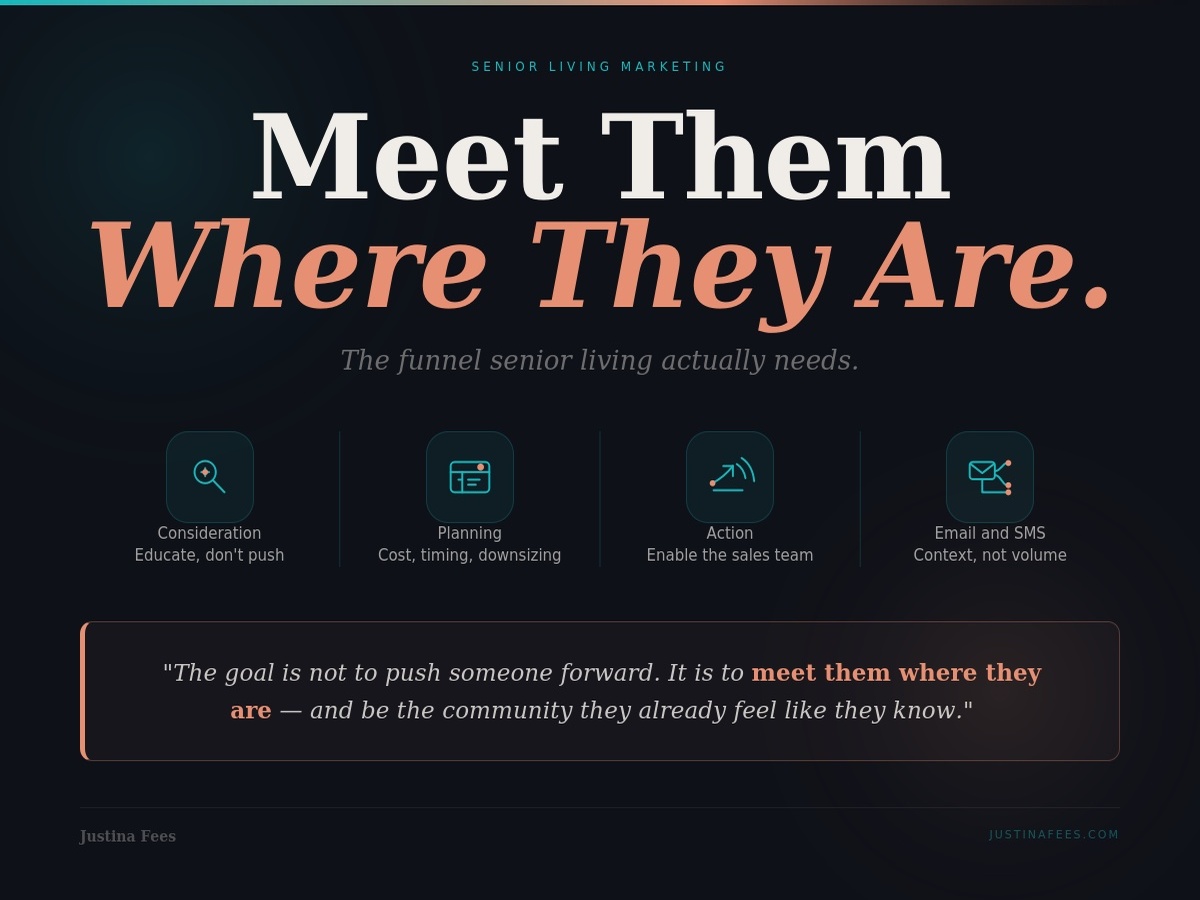
This is the idea behind The Funnel Senior Living Actually Needs. Instead of pushing people through a process, the goal is to meet them where they are. And that is where conversion starts to improve in a way that holds, because the system is finally aligned with the person it is supposed to be serving.
What Better Actually Looks Like
A better system is not more complicated. It is more intentional. It guides instead of overwhelms. It gives people options based on where they are in the process rather than assuming everyone is in the same place. It builds understanding before asking for commitment. It connects marketing to sales in a way that feels like a handoff instead of a drop, with the context the sales team needs already in place before the first call. And it gives real visibility into what is working, not just what is generating activity.
This is where supporting content matters more than most operators think it does. Not just service pages and amenity pages, but content that answers the questions families are actually asking before they ever reach out. Cost. Timing. Readiness. Whether this is even the right decision yet. Whether memory care is the right call or whether assisted living can hold for another year. How to have the conversation with a parent who is insisting they are fine. A website built around those questions converts differently than one built around what the community wants to say.
And the difference is not subtle. The communities that are willing to publish the content that addresses cost honestly, timing realistically, and readiness without pressure tend to build trust faster than any amenity tour or virtual walkthrough ever will. The communities that hide cost behind a contact form, or treat readiness questions as objections to overcome, are the ones whose conversion data never quite matches their content output.
But Better Is Not the Same as Effective
A better website does not guarantee conversion. More leads do not guarantee move-ins. More tools do not guarantee better outcomes. If the system is not aligned, the same problems keep getting solved at a higher cost. The metrics get better on paper. The occupancy does not follow. And at some point the gap between those two numbers becomes the real conversation, the one that has to happen before any new platform or any new agency can actually move the dial.
Senior living marketing has improved significantly. The investment is real. The awareness is there. The infrastructure is catching up to the rest of the digital economy. But most systems were built in pieces, at different times, by different people, for different reasons. And nobody went back to look at whether those pieces add up to something coherent from the outside looking in.
That is the work that does not show up in a redesign deck or a platform demo. It is also the work that determines whether any of the other investments actually translate into occupancy.
Start Simple
If the expectation coming into this post was a clear list of steps, a checklist, something broken down into bullet points because that is how most content gets consumed now, that makes sense. It is how searching works. The AI overview gives the answer and you move on.
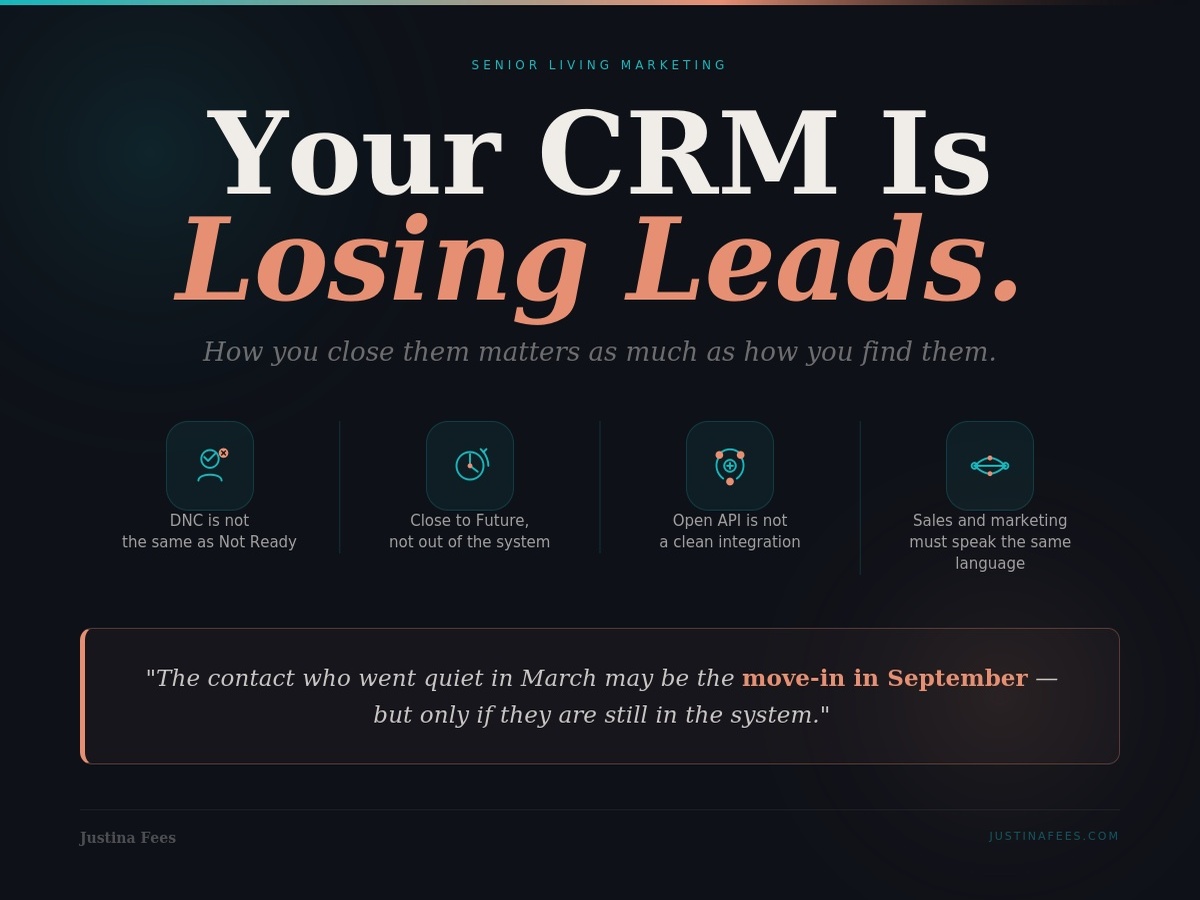
But the honest answer is that the right next step depends entirely on what is already in place. Without knowing what the CRM looks like, how leads are being closed, what the handoff between marketing and sales actually involves day to day, what the automated sequences are doing in the background, it is impossible to say what needs to change. How to Set Up Your Senior Living CRM So You Stop Losing Leads goes deeper into that side of the system, but even that starts with looking at what is already there before recommending anything new.
Before adding another platform, before commissioning another rebuild, before signing the next agency retainer, the more useful move is to step back and look at the full process from the first click to the final decision. Where does it feel unclear? Where does it slow down? Where does it break? What is the system actually doing versus what everyone assumes it is doing? Those are not questions a checklist can answer. But they are the questions that most organizations skip in favor of getting the next thing live.
That is why senior living marketing is better and still feels broken. Not because the tools are wrong. Because the system underneath them was never really designed as a system.
If any of this sounds familiar, let’s talk.