Most senior living marketing funnels are built backwards.
They start with the community. What we offer. What makes us different. What leadership wants to highlight this quarter. And then everything gets built outward from there, campaigns, emails, follow-up sequences, SMS touches, all designed to move someone toward a decision on the community’s timeline.
The problem is that the person on the other side is not on that timeline.
They never were.
And until the funnel is built around where they actually are, not where the system wants them to be, the activity keeps happening without turning into occupancy.
This post is about building something different. Not more complex. More intentional. A funnel that starts with the person, accounts for the reality of this decision, and uses email, SMS, and downstream marketing in a way that actually supports the sales team instead of creating noise for them to manage.
Most of what is here came from being inside these systems. From watching the gaps show up in real time. From understanding why something that looks right on paper can still feel completely broken in practice.
Two Funnels. One Broken System.
Before getting into the funnel itself, it helps to establish something that does not get talked about enough.
A funnel, at its most basic, is just the path someone takes from first awareness to final decision. They hear about a community. They learn more. They consider their options. They act.
Every community has one, whether it has been built intentionally or not.
But in senior living, there are actually two funnels running at the same time, and confusing them is one of the most common reasons systems break down.
The marketing funnel starts long before anyone picks up the phone. It covers the entire period when someone is researching, educating themselves, comparing options, and trying to understand whether this is even the right move. This funnel is often invisible to the sales team because it happens quietly, through Google searches, late-night website visits, downloaded guides, and unanswered chatbot questions. The goal of the marketing funnel is not to close anyone. It is to build enough trust and clarity that the right person eventually raises their hand.
The sales funnel begins the moment that hand goes up. Someone calls. Someone fills out a form with a real phone number. Someone books a tour. Now a human being takes over and the job shifts from education to relationship. The sales funnel is what the community director tracks. It is what shows up in the CRM pipeline. It is what gets reported to ownership.
Both matter. But they require different strategies, different timelines, and different measures of success.
The problem in most senior living systems is that the marketing funnel barely exists. There is paid media driving traffic, a website that catches it, and a form that hands it off to sales, with almost nothing in between to support the person who is not ready yet. So the sales team ends up working contacts that are too cold to close, and marketing gets blamed for lead quality, and everyone is frustrated.
That gap between awareness and readiness is exactly where this post lives.
This Is Not a High-Velocity Vertical
Senior living is not e-commerce.
It is not SaaS. It is not real estate in the traditional sense. It is not a category where someone sees an ad on Monday and converts by Friday.
The average decision cycle can span months. Sometimes longer. The person researching memory care options today may not be ready to tour for another six months. The adult daughter who downloaded a pricing guide is probably managing a full-time job, her own family, and a parent who is still insisting they are fine.
This matters because the instinct in most marketing funnels is to create granular, behavior-triggered sequences that fire based on micro-actions. Someone visits the memory care page twice, trigger a sequence. Someone opens three emails, move them to a hotter segment. Someone fills out a form, call them within five minutes.
Some of that thinking applies here. But not all of it.
When a funnel gets over-engineered in a low-velocity vertical, the result is a system that feels aggressive to the person going through it and chaotic to the sales team trying to work it. A lot of motion with very little meaningful movement.
The goal is not granularity for its own sake. The goal is relevance. And relevance in senior living comes from understanding which phase of the journey someone is actually in and meeting them there with the right message, the right offer, and the right amount of pressure. Which, for most of this journey, is very little.
Start With the Entry Point
If you have read Senior Living Marketing Is Better. So Why Does It Still Feel Broken? you already know that one of the biggest gaps in most systems is that marketing gets built from the inside out. The community decides what to say and then figures out how to say it.
A better starting point is the entry point.
Where did this person come from? What did they click on? What did they search for before they landed on the site? What did they engage with before they filled out that form or started that chat?
Those signals tell you something. Not everything. But something.
Someone who searches “how to pay for assisted living” and lands on a cost calculator is in a different place than someone who searches “assisted living near me” and requests a tour. Both are valuable. They are not the same person. And they should not receive the same follow-up.
The entry point is the first piece of real context available. Everything else gets built from it.
Four Phases. Not a Pipeline.
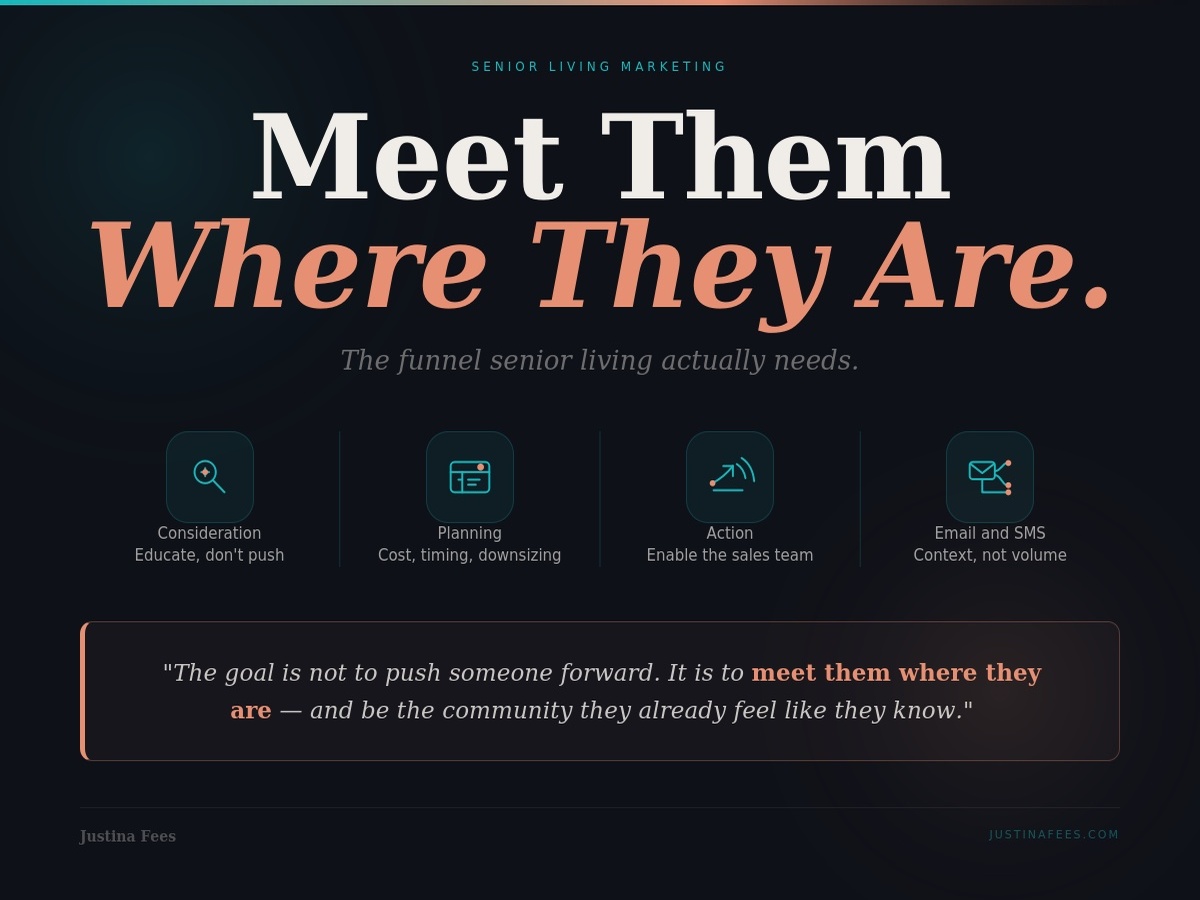
Rather than mapping out a complex matrix of triggers and conditions, the most practical approach for senior living is to place contacts into four broad phases. Think of these less as stages in a linear funnel and more as buckets that reflect where someone is emotionally and practically in the process.
People move between these buckets. They do not always move forward. Someone in the action phase gets a health scare and retreats back to consideration. Someone in the planning phase has a family conversation that changes everything. A system that accounts for that fluidity will always outperform one that forces a rigid progression.
Consideration
This is the earliest phase. The person, often an adult child, sometimes the future resident, is just starting to understand that something may need to change. They are not ready to talk to anyone. They are researching quietly, often at odd hours, often on mobile.
What they are looking for is information without pressure. Context without commitment. They want to understand what senior living even means, what the options are, what things cost in general terms, and whether they are even at the point where this is a real conversation.
The content that matters here is broad. Blog posts that answer real questions. A cost overview that does not require a form fill. Resources around care levels. A website experience that guides rather than pushes.
Email marketing in this phase should be low-frequency and educational. One email every one to two weeks. No urgency language. No “spots are filling up.” Just useful information that helps someone understand what they are navigating. If a lead nurture platform is in place, this is where a well-written drip sequence earns its keep, not by pushing for the tour, but by being the resource that keeps showing up when it is needed.
Supporting actions to think about in this phase:
- Is it the right time for senior living?
- What is the difference between independent living, assisted living, and memory care?
- How do you even start this conversation with a parent?
Planning
The person has moved past general awareness. They now accept, at least intellectually, that this is a real possibility. They are starting to think practically. What would this actually look like? What needs to get figured out before anything can happen?
This is where two of the biggest supporting decisions start to surface: financing and downsizing.
Financing is not a secondary concern. For most families it is the central one. “Can I actually afford this?” is the question that stops more families in their tracks than almost anything else. And yet most senior living marketing glosses over it. The communities that address it directly, with real content around how to think about costs, what to look at, what options exist, tend to build trust faster than any amenity page ever will.
Downsizing sits right alongside it. The family home is often the primary asset and the primary emotional anchor. Helping someone think through what it means to downsize, how to approach it, what the timeline looks like, that is not a distraction from the marketing. That is the marketing. Because the person who feels supported through that question is far more likely to come back.
Email in this phase can be slightly more direct. The community can start showing up more explicitly. Invitations to events. Links to virtual tours. Content that moves from understanding the category to understanding a specific community. Frequency can increase modestly. SMS can start to play a role here, particularly for event reminders or a gentle nudge after a specific action like a resource download or a repeated page visit.
Supporting actions to think about in this phase:
- Can I afford senior living?
- How do I approach financing long-term care?
- Is it the right time to downsize, and how does that process actually work?
Action
Someone in the action phase is ready to move. They have done the research. They have had the hard conversations. They are now actively evaluating options. This is where the sales team is most relevant, and where the marketing funnel’s job shifts.
The role now is not to nurture. It is to enable.
That means making sure the sales team has the context they need. Who is this person? What did they engage with? How long have they been in the system? What content did they consume? What questions did they ask the chatbot? If the CRM is not surfacing that information, the handoff breaks, and a broken handoff is one of the most expensive things that happens in a senior living marketing system.
Email and SMS in this phase become more tactical. Tour confirmation. Follow-up after a visit. A well-timed message after a family meeting. These should not feel like automated blasts. They should feel contextual, tied to something that actually happened.
This is also where the difference between a template and a real message becomes most visible.
Denial
There is a phase that does not get talked about enough. It sits somewhere between consideration and planning, and it does not move on anyone’s schedule.
The parent who insists they are fine. The adult child who knows something needs to change but cannot bring themselves to push the conversation. The family that keeps saying “not yet” even when “not yet” is starting to carry real risk.
These contacts exist in every database. They filled out a form. They downloaded the pricing guide. They have a real email address, but their name is something like “John Smith” and their phone number is all zeros.
They gave just enough to get the information they needed. They were not ready to be contacted. They just needed to know what it costs and were not willing to trade their privacy for it.
This is not a lead quality problem. It is a trust problem.
The answer is not a more aggressive follow-up sequence. It is better content that does not require a trade to access, combined with a remarketing strategy that stays visible without being intrusive. These people are watching. They are not ready. But when they are, the community that already feels familiar is the one that gets the call.
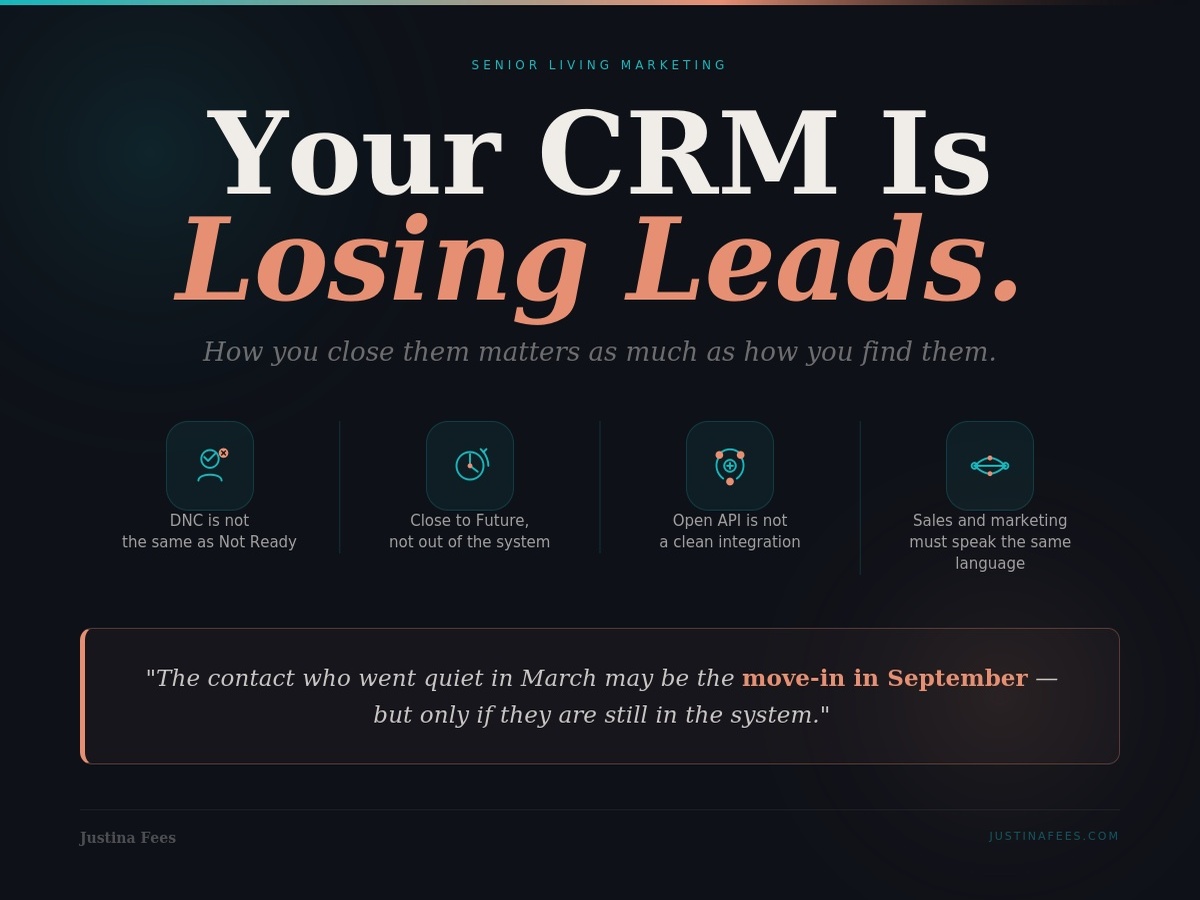
One thing worth mentioning here that does not get enough attention: how these contacts get closed in the CRM matters. If someone has a real email address but a fake name and no phone number, closing them as “not interested” or “do not contact” cuts them off entirely. That is not the right call. If there is anything viable in that record, close them to a future or long-term nurture status instead. That keeps them eligible for a re-engagement campaign down the road, which is exactly where contacts like this belong. How you set up those disposition categories, and how you build the segments around them, is its own conversation. But the instinct to just close and move on is one of the quieter ways leads get lost permanently.
The nurture strategy for this segment is long. Patient. Almost entirely one-directional until they signal otherwise.
Email and SMS — Platform Reality
There are solid platforms available for senior living email and SMS marketing, HubSpot, ActiveDEMAND, and purpose-built options like Sherpa, WelcomeHome, and Talk Further all offer automation capabilities of varying depth.
Talk Further has built a genuinely impressive AI-driven communication layer. Anyone who has called a community and spoken with Sofie already knows the level of sophistication that exists in this space right now.
But here is a question worth sitting with.
Talk Further serves somewhere in the range of 7,000 clients nationwide. How many of those communities are running the same ready-made templates? How many senior living families are receiving the same automated follow-up email from a different community, with the name swapped at the top?
Templates are a starting point. Not a strategy.
This is not a criticism of the platforms. The platform is only as good as the customization layer built on top of it. And that customization layer requires someone who understands the business, understands the person on the other end, and has the time and expertise to build something that actually reflects both.
Which raises a more important question than which platform to use: who is managing it?
If it is an agency, how deep do they actually go into the content of the sequences? Are they writing communications that reflect the emotional reality of this decision, or are they checking a box and sending a monthly report?
If it is the platform provider directly, what does their ongoing support actually look like? Is there capacity to customize for a specific community, or does every client get the same playbook?
There is no single right answer. But it is worth understanding the difference before assuming the platform is doing the work.
This Is Not a Replacement for the Sales Team
Say this clearly and say it often.
Automation is not a substitute for human connection in senior living. It never will be.
The families going through this decision need real conversations. They need someone who can answer the hard questions honestly, who can hear the hesitation in a voice and respond to it, who can sit across from an adult child and say they understand and actually mean it.
What a well-built email and downstream marketing system does is get that person to the right conversation at the right time, instead of burning out a sales team chasing contacts who are nowhere near ready.
It filters. It educates. It maintains visibility during the long quiet stretches of the decision cycle. It surfaces context that makes the sales conversation more meaningful when it finally happens.
Done well, it does not replace the sales team. It puts better information in front of them. It gives them a warmer lead, a more informed prospect, and a follow-up system that handles the maintenance so they can focus on the relationships.
The sales team closes. The funnel creates the conditions for closing.
Those are different jobs. Both matter. And when they are built to work together, with clear handoffs, shared context, and aligned messaging, the whole system gets better.
Start Simple. Stay Intentional.
None of this has to be built all at once.
Start with the entry point. Understand where contacts are coming from and what that signals about where they are in the journey. Build a simple phase structure and create content that is genuinely useful at each one.
Add SMS thoughtfully, not reflexively. Use it for timely, contextual touches, not volume plays.
Audit what the platform is actually doing versus what it looks like it is doing. Read the emails. Ask whether they sound like the community or like every other community running the same stack.
And keep the person at the center of all of it.
Not the funnel. Not the platform. Not the report.
The person who is trying to figure out one of the hardest decisions their family will ever make.
Build for them, and the rest follows.
If any of this sounds familiar, let’s talk.